This post argues that engagement in class struggle, while necessary, does not by itself generate an adequate theoretical understanding of capitalist society. A widespread tendency within radical activism treats practice as a substitute for theory, leading to persistent confusions not only about exploitation, but also about the state, law, and the mechanisms through which capitalist domination is reproduced. I develop this argument through a critical engagement with the writings of John Clarke, treating them not as an isolated failure, but as symptomatic of a broader methodological problem on the left.
Introduction
I want to start with an hypothesis: many activists in practice assume that it is unnecessary to engage in theory in any rigorous manner (even if they claim the contrary) since they engage in practice—they are activists. John Clarke, a former major organizer of the defunct organization Ontario Coalition Against Poverty, illustrates this hypothesis in many ways.
Having read and reviewed Sarah Glynn and John Clarke’s pamphlet Climate Change is a Class Issue (2024) (see for example one of a series Review of the Pamphlet “Climate Change is a Class Issue” by Sarah Glynn and John Clarke, Part One: A Critique of the Identification of the Exploitation of Workers by Employers and the Exploitation of the Natural World), I have shown that this work fails to engage Marx’s theory of worker exploitation; it treats the exploitation of nature and workers as effectively identical and ultimately prioritizes climate change over worker exploitation in both theory and practice.
In addition, I went through all the posts in John Clarke’s blog, and there is only one post that engages with that theory in any detailed way. I include the entire post as an appendix at the end of this post.
I will not analyze this argument in the order in which it is presented in the post. Rather, I will analyze it in an order that hopefully will bring out its inadequate nature.
Being a Radical Activist Is a Necessary but Hardly a Sufficient Condition for Grasping the Capitalist Nature of the Exploitation of the Working Class
Clarke claims the following:
If an understanding of social reality, is in the interests of an exploited class, then that understanding won’t be arrived at through a process of contemplation. The class lie of the capitalist class must be exposed and refuted in the course of the class struggle. Having said that, there is also a decisive role for analysis and political organization.
However, these two factors are entirely interconnected. A clear understanding of the exploitative nature of this society can’t be discerned simply from direct experience of the labour process as a worker. On the other hand, Karl Marx could only grasp the real exploitative mechanisms at work under capitalistm because he was a revolutionary and, as such, was free of the restrictive class interests that Lukacs described.“
Let us look at this last sentence. Clarke implies that it was because Marx was a revolutionary that he “could only grasp the real exploitative mechanisms at work under capitalism.” This view is certainly debatable.
Firstly, Engels, Marx’s lifelong friend and comrade, was a revolutionary, but he did not develop the theory of capitalist exploitation.
Secondly, Marx, even though he participated in the 1848 German revolution, did not express a “very high level of comprehension” of the exploitation of the working class at the time. It is probable that he did not clarify (and hence attain “a very high level of comprehension” of the working-classes’ exploitation until around 1857, when he drafted a manuscript titled Outlines of the Critique of Political Economy (also known as the Grundrisse (which means Outlines in German). Marx had studied political economy since 1844—and yet it took him around 13 years to gain a clearer comprehension of the nature of the exploitation of the working class by capital and capitalists (people who consciously carry out the general process of exploitation without necessarily being conscious of the exploitation of the working class).
Thirdly, Clarke forgets his own contradictory history. It was not that long ago that he himself used such expressions as “decent wages”–and anyone who considers workers to be exploited would never use such an expression. Thus, On Mr. Clarke’s blog, on June 15, 2021, he has written a post titled “A Basic Income in Waiting?” (https://johnclarkeblog.com/node/65). He wrote: “We need to fight employers to win decent wages… [my emphasis].”
If Clarke took seriously Marx’s theory of exploitation in 2021—just four years ago–he would never have referred to such a fiction as “decent wages.”According to Clarke’s own blog: “I was first elected as an organizer with OCAP in 1990 and stayed in that role for some 28 years.” So, from 1990 until around 2018, Clarke was an activist and an organizer for OCAP. However, despite being an activist and an organizer for 28 years, three years later, in 2021, he wrote something that expresses a lack of understanding of Marx’s theory of exploitation.
In addition, as has already been shown in my posts reviewing Sarah Glynne and Clarke’s pamphlet, Clarke’s understanding of Marx’s theory of class exploitation is very one-sided—and that despite Clarke’s engagement in what he calls “class struggle.”
It can be concluded that being a revolutionary or at least an activist may be a necessary condition for having developed a theory of the exploitation of workers, but it is hardly a sufficient one. It can also be concluded that being an activist is hardly a sufficient condition for coming to understand the nature of capitalist exploitation. Much more is required than engaging in practice or in being an activist.
Such a conclusion contradicts Clarke’s own implicit anti-intellectualism. He writes:
If an understanding of social reality, is in the interests of an exploited class, then that understanding won’t be arrived at through a process of contemplation.
To be sure, academic leftism or academic Marxism will not gain an understanding of many aspects of class exploitation since they ignore many features relevant for characterizing class exploitation and oppression (see, for example, my critique of the academic leftist Jeff Noonan, in The Poverty of Academic Leftism, Part Nine: The Nature of Capitalism). However, it is also unlikely that “an understanding of social reality … in the interests of the an exploited class” will arise and “be exposed and refuted in the course of class struggle.” Clarke’s own limited understanding of capitalist exploitation, again, provides evidence that refutes his own assertion.
How is Clarke really exposing the specific nature of capitalist exploitation with his vague references to exploitation? With his failure to distinguish between class exploitation and class oppression (see my review referenced above)?
Merely being engaged in “practice” or being an “activist” hardly suffices to ensure that the working class has the theoretical tools necessary to “understand [capitalist] social reality.”
Relevant here is something that I wrote in a published work comparing John Dewey’s philosophy of education (Dewey was an American philosopher of education in the late 19th century to one third of the 20th century). to the radical pedagogue Paulo Freire’s philosophy of education (Freire is the author of the book Pedagogy of the Oppressed). From F. Harris (2017), “Dewey’s and Freire’s popular philosophies of education in a capitalist context,” in pages 100-117, Encounters in Theory and History of Education, Volume 18, page 110:
Freire tends to make leaps of faith from oppression and exploitation to their complete abolition without any specification of the conditions necessary for their abolition. There is too little mediation process in his theory and practice. The complexity of understanding the capitalist world requires more rigorous inquiry, a rigour reflected in Dewey’s view of the nature of scientific inquiry. [John Dewey was a United States philosopher.]
Freire considered himself to be a socialist; he believed in class struggle. However, his theory was insufficiently robust or powerful to engage practically with the specificity of class exploitation in a capitalist society–and I suspect Clarke shares similar flaws.
In addition, Clarke claims that “the class lie of the capitalist class must be exposed and refuted in the course of the class struggle.” Okay. How does Clarke propose to do that? By inadequately comprehending the nature of capitalist exploitation?
Appendix
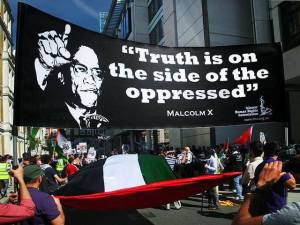
“TRUTH IS ON THE SIDE OF THE OPPRESSED”
Submitted byJohnnew onFri, 02/24/2023 – 19:27
The title of this article is taken from a speech that Malcolm X gave in Harlem, New York City, in 1964. In the course of it, he told the crowd that “Time is on the side of the oppressed today, it’s against the oppressor. Truth is on the side of the oppressed today, it’s against the oppressor. You don’t need anything else.”As a fighter on the side of the oppressed, Malcolm offered a vital insight that day on the great power of the truth as a weapon in the struggle to transform society and his proposition contained a lot more than wishful thinking.
Ruling classes have always known that the truth can be enormously dangerous and have generally kept a large portion of it off limits to the mass of people.Class liesCorporate news sources and social media provide an ongoing torrent of evidence that those who are dominant in this society wish us to accept a world view that conforms to their interests. A few examples of what I mean might be useful. The occupation of Palestine and an intensifying effort to complete the process of colonial dispossession unfolds before our eyes. Yet, how many media accounts do we read of Israeli attacks Palestinians that are presented as if two quite equally matched opponents were confronting each other?
The ‘clash’ has become the term of choice to render invisible an oppressive reality and a massive disparity in terms of armed power.The Zionist project is but one particularly brutal manifestation of the imperialist world order. There is a global division between oppressed and oppressor countries that involves vast inequality and crushing poverty. Yet the most powerful and influential institutions of global capitalism would have us believe that huge gains have been made in ‘poverty reduction.’ The dubious methodology they employ to advance this analysis has been very credibly refuted but their ability to dominate the official discourse protects their myth making from successful challlenge.
There is a huge body of evidence concerning the egalitarian nature of the hunter gatherer societies that existed for tens of thousands of years. It is also compellingly argued that the emergence of social classes, private property and inequality were linked to the development of agriculture perhaps 10,000 years ago. Still, the claim that the competitive social values of capitalist society reflect an unchanging ‘human nature’ is promoted relentlessly as common wisdom.The accelerating climate disaster that humanity faces may have taken many of us by surprise but not the fossil fuel companies. We learn that Exxon has known since the 70s that carbon emissions were going to lead us into this dire situation. Yet they deliberately misled the world, with a systematic campaign of climate denial propaganda. These days, the cat is so far out of the bag that crude denial has had to give way to delay and evasion but these are being pursued with vigour. The myth of ‘green capitalism’ is being fostered and the dubious promise of the tech fix is advanced with flourish, even as the destructive behaviour of the oil and gas sector proceeds unabated.The distortion of truth and the promotion of falsehood are elements of this society because they reflect ruling class interests. This class can’t possibly acknowledge the full dimensions of its exploitative role. Even if millions of workers appreciate that it is their labour makes their employers rich, a precise understanding of the nature of the exploitation is discouraged and countered in a thousand ways. A steady flow of counter arguments are advanced, ranging from the billionaire philanthropist, to the ‘Great Reset’, to the ‘trickle down theory’ that would have us believe we will all somehow share in the bounty created by capitalist profit making.Apart from the need to deceive working class people, the capitalist class is incapable of looking reality in the face for a more fundamental reason. It’s ability to survive and function demands that it must consider the system it presides over as the highest form of society while adamantly denying its historically limited shelf life. The capitalists and their intellectual enablers could never even consider the kind of conclusions of Friedrich Engels drew in ‘Socialism, Utopian and Scientific.’‘On the one hand, therefore, the capitalistic mode of production stands convicted of its own incapacity to further direct these productive forces. On the other, these productive forces themselves, with increasing energy, press forward to the removal of the existing contradiction, to the abolition of their quality as capital, to the practical recognition of their character as social production forces.’
In his ‘History and Class Consciousness,’ Georg Lukacs, offered some important insights into this question of how fully a class is able embrace social reality.
‘It must not be thought, however, that all classes ripe for hegemony have a class consciousness with the same inner structure. Everything hinges on the extent to which they can become conscious of the actions they need to perform in order to obtain and organise power.’
He went on to argue that
‘The fact that a scientifically acceptable solution does exist is of no avail. For to accept that solution, even in theory, would be tantamount to observing society from a class standpoint other than that of the bourgeoisie. And no class can do that – unless it is willing to abdicate its power freely. Thus the barrier which converts the class consciousness of the bourgeoisie into ‘false’ consciousness is objective; it is the class situation itself. It is the objective result of the economic set-up, and is neither arbitrary, subjective nor psychological. The class consciousness of the bourgeoisie may well be able to reflect all the problems of organisation entailed by its hegemony and by the capitalist transformation and penetration of total production. But it becomes obscured as soon as it is called upon to face problems that remain within its jurisdiction but which point beyond the limits of capitalism.’
No ruling class can possibly draw the stark conclusion, however overwhelming the evidence may be, that it has become historically anachronistic. Surely, the relentless pursuit of oil and gas profits that are drawn from productive activity that threatens the very existence of life on this planet must be considered a vindication of Lukacs’ conclusions and the strongest possible proof of the durability of the class lie.
Class truth
There is now an obvious need to consider the other side of the question. If the capitalist class can’t look reality in the face, how do things stand for the working class? I’ll argue that the very same factor of class interests that Lukacs considered drives the exploited class towards a full and clear understanding of the workings of this society and the influences that limit its time on earth. As true as this is, however, there are some very substantial countervailing tendencies that serve to block that understanding.
First of all, oppressed classes reflect their oppression in their consciousness. In ‘The German Ideology,’ Marx and Engels famously asserted that ‘The ideas of the ruling class are, in any age, the ruling ideas.’ This is so much the case that most working class people accept those dominant ideas most of the time to a very considerable degree. It is at times of social crisis, when masses of people are drawn into struggle, that the grip is loosened and a leap in thinking can occur.
Moreover, such leaps in thinking are only possible because they are resisted for greater or longer periods. The development of working class consciousness is therefore uneven and periodically explosive. As Trotsky put it in his ‘History of the Russian Revolution,’
‘The swift changes of mass views and moods in an epoch of revolution thus derive, not from the flexibility and mobility of man’s mind, but just the opposite, from its deep conservatism. The chronic lag of ideas and relations behind new objective conditions, right up to the moment when the latter crash over people in the form of a catastrophe, is what creates in a period of revolution that leaping movement of ideas and passions which seems to the police mind a mere result of the activities of “demagogues.”’
It is also true that, while capitalism has produced an exploited class that carries out the labour process in a form that provides opportunities for resistance and social transformation that earlier societies lacked, the function of exploitative is rendered less clear. The slaves worked for the slave owner because they were his property and acted under physical compulsion. The feudal peasants were tied to the land of by law and custom and had very little ability to alter that. Things are somewhat different for modern workers, however.
Since we are considering class lies, the mythical ‘fair day’s work for a fair day’s pay’ is one of the biggest in this society. As Marx showed, the wealth of the capitalists, however much they may see it as resulting from their business skills and competitive antics, comes from that portion of the workers’ labour for which they receive no compensation. If workers put in eight hours’ labour and get paid for only four, the unpaid portion goes into the capitalist’s pocket. The ‘surplus value’ stays with the exploiter.
The workers aren’t actually paid for the work they perform. The capitalists buys the commodity of ‘labour power’ or the ability to work from workers and pays them at its value. This is determined by the value of the goods and services the workers must purchase in order to renew their labour power. Once the capitalists have paid for it, however, they have in their possession a commodity that creates value and they milk it for all its worth. Indeed, this particular commodity has the capacity to create far greater value than it is itself worth.
This exploitative reality isn’t nearly as apparent as it was for slaves, who could readily see that they worked as directed and only got back what their owners provided in the form of food, clothing and shelter. For modern workers, though they widely view their employer as an exploiter, the unpaid portion of their labour is not immediately identifiable. The agreement they enter into with the capitalist creates the illusion that they are being paid for the work they perform. As Marx put it in ‘Wage Labour and Capital,’
‘(Workers) would all agree upon one point: that wages are the amount of money which the capitalist pays for a certain period of work or for a certain amount of work. Consequently, it appears that the capitalist buys their labour with money, and that for money they sell him their labour. But this is merely an illusion. What they actually sell to the capitalist for money is their labour-power.’
Class interests
These difficulties in arriving at the truth notwithstanding, it remains clearly in the interests of the working class to embrace it. If the capitalist class needs to conceal the exploitative process and pretend that the society that has developed around it is unchanging and inevitable, the working class is in the opposite situation. It has an interest in understanding the nature of its exploitation, so as to abolish it. If the social and economic system that oppresses it is of limited duration, that is not an inconvenient reality to be denied but an opportunity to be acted upon.
What emerges in this, however, is the need for a very high level of comprehension. When the capitalist class took power from its feudal predecessors, it had neither the ability to fully understand the social change it was initiating or an interest in doing so. It could wrest power from a rival exploiting class with very imprecise ideas that were significantly couched in religious terms.
Since the capitalist class was only a replacement set of exploiters, it needed a mass of people to send against against its feudal rivals. It is now very clear the promises of ‘liberty, equality and fraternity’ should have been taken with a much larger pinch of salt than they were. Even as Cromwell set in motion a revolutionary army against the kingly power, his leading generals were informing the lower orders, at the Putney Debates, that their share of the new liberty would be strictly rationed.
If an understanding of social reality, is in the interests of an exploited class, then that understanding won’t be arrived at through a process of contemplation. The class lie of the capitalist class must be exposed and refuted in the course of the class struggle. Having said that, there is also a decisive role for analysis and political organization.
However, these two factors are entirely interconnected. A clear understanding of the exploitative nature of this society can’t be discerned simply from direct experience of the labour process as a worker. On the other hand, Karl Marx could only grasp the real exploitative mechanisms at work under capitalistm because he was a revolutionary and, as such, was free of the restrictive class interests that Lukacs described.
The present period we live in, a time of societal crisis when the class struggle is escalating and the importance of socialist ideas is greatly elevated, makes the truth particularly precious. The working class, in all its great diversity comprising the many pitted against thefew, has an interest in understanding the fundamental limitations of this society and in fighting for a new one. It does so, moreover, not as a new exploiting class but as a social force that can bring exploitation and oppression to an end. In this regard, it has nothing whatever to hide or to hide from.
On that day in Harlem
in 1964, Malcolm X delivered a message that he lived by and that we need to act upon. “Truth is on the side of the oppressed.”

 The Abolitionary