The Socialist Project recently posted an article by Toronto & York Region Labour Council (T&YRLC) on their defense of the right to strike and the right to protest (civil liberties):
In Toronto and York Region, we are witnessing an alarming rise in anti-democratic, anti-worker motions being introduced by municipal Councillors. Using various pretexts, members of council in Toronto and York Region municipalities are moving motions which seek to limit the charter protected rights of free expression and free assembly. In particular, these motions use the spectre of public safety to crack down on protests which disrupt “critical infrastructure,” a dog whistle for anti-union interventions from government.
Over the last several months, we have seen a dramatic rise in protests across the country to decry the escalating violence in Israel-Palestine, and to call for an end to the blockade and to send immediate aid to the people of Gaza. The Toronto & York Region Labour Council has supported the calls made by trade unions and working people across the world to take drastic action toward an immediate ceasefire, for aid, and an end to the blockade.
Overwhelmingly, the countless actions which have taken place in Toronto and York Region have been peaceful assemblies of working people urging the government to take action and oppose the ongoing violence. This mass movement of working people has made gains, with Parliament passing a motion on March 18th for a ceasefire, a restoration of humanitarian aid to Gaza, and an embargo on arms sales to Israel.
While these demonstrations have overwhelmingly remained peaceful, members of councils in Toronto and in York Region have highlighted the infrequent disturbances during the protests, along with a rise in hate crimes, particularly Islamophobic and anti-semitic hate crimes, as motivation for their by-laws. The Toronto & York Region Labour Council unequivocally condemns racism, discrimination, antisemitism, Islamophobia, hate, and all forms of oppression and exploitation, as it has through many years of its struggle for a better city, and a better world. Urgent action must be taken by all to end hate in all its forms.
Nonetheless, we reject the move to stifle and restrict charter protected rights which have been fought for by working people over centuries. It is worth noting that the activity the police and politicians have been fear mongering around is already illegal; harassment, destruction of property, violence, hate, and so on. It is because these protests have been peaceful and lawful that they seek to expand their powers. Granting extra powers to police and by-law officers will not serve to protect working people from activity which is already illegal, instead it will only serve to undermine and weaken Canadian democracy.
It is no coincidence that expanded calls for protecting “critical infrastructure” comes after a high-water mark for militant trade union activity in 2023. Responding to a cost-of-living crisis which has gripped working people across the country, and seeing their real-wages and living standards decline, workers struck back.
Across the country, strikes shook employers who remained obstinate in addressing workers’ growing concerns. In 2023, we saw the largest single employer strike in Canadian history with the PSAC strike; one of the largest general strikes in Canadian history with the Common Front in Quebec; and there were also militant walk outs ranging from dozens to thousands of workers in the logistics industry, manufacturing, the service sector, healthcare, and education, among others. In all, working people went out for more than 2,225,000 working days in 2023, shattering the trend for the prior decade.
Working people’s unwillingness to accept less than they are worth has led to a renewed push to attack the labour movement and weaken labour rights across the country. This push comes in the form of both legal and extra-legal interventions intended to hamper union organizing, activity, and, particularly, weaken the strike as a viable tactic.
Legislation of this type has been used to attack labour in Toronto & York Region recently, as well as across the province, and country. In Toronto, there have been motions in council to review and expand the system of monitoring and policing protests in the city, in particular by James Pasternak, no friend of working people; in Vaughan, a motion from Steven Del Duca, which limits the ability to protest in certain areas, including schools and other pieces of “critical infrastructure”; in Black River-Matheson, all members of CUPE in Canada were served a trespass notice to try and smash the lawful strike of municipal workers in the city; and in Ottawa, by-laws have been arbitrarily enforced to intimidate and restrict the rights of working people to protest.
Stifling democracy is the purpose of these legislative attacks stacking up across the country, and some of the most vicious are coming from the Ford Government, with the recent bills 124 and 28 representing what’s to come – a serious attack on workers rights. Both bills were found unconstitutional, and many others are being challenged in court right now.
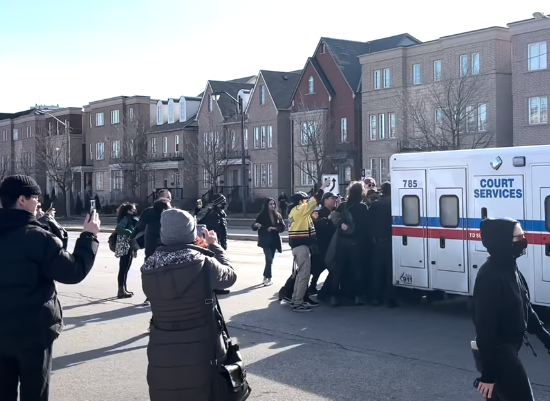
Arresting striking workers at York University.
Worse yet, these legislative attacks on working people have risen in parallel to an absolute, and often violent, crackdown from the police on peaceful protest and strike activity. In Toronto, this crackdown has manifested in the intimidation and arrest of lawfully striking CUPE 3903 members who were exercising their right to strike and picket at the same locations they have for over 20 years, as well as the widespread crackdown on and brutalization of Palestinian solidarity activists in the city. These escalations are not a coincidence, and the police response foreshadows the new world legislative attacks of working people seeks to build.
While it is likely that, similar to other recent attempts to restrict the rights of working people, these by-laws being passed and reviewed by councils in Toronto and York Region would be found unconstitutional, they nonetheless represent a serious affront to working people everywhere. These rights were won through hard fought struggles from working people over many years, and the Toronto & York Region Labour Council stands firmly and resolutely in defence of them.
We also stand in defence of these rights for groups legally protesting on other issues, including the situation in Israel-Palestine.
The Labour Council resolves to:
Call on all of its affiliates to vigorously oppose legislative attempts to limit the right to demonstrate, protest, rally, and strike.
Demand members of council withdraw motions which seek to limit protected charter activity and seek no further avenues, legal or extra-legal, to restrict charter rights.
Reiterate our call for an immediate ceasefire in Israel-Palestine and a negotiated solution to the conflict. •
Since 1871, the Labour Council has championed principles which improve the lives of its members and their communities. Today, we work for justice in our workplaces [my emphasis], in our politics, in our communities, and in our world
I certainly agree that workers, citizens, immigrants and migrant workers need to defend the right to strike and the right to protest, and the T&YRLC should be supported on that score. However, T&YRLC should not be impervious to criticism because it claims to defend such rights–especially when it simultaneously claims the following:
The Toronto & York Region Labour Council unequivocally condemns racism, discrimination, antisemitism, Islamophobia, hate, and all forms of oppression and exploitation [my emphasis], as it has through many years of its struggle for a better city, and a better world. Urgent action must be taken by all to end hate in all its forms.
In the first place, the statement contradicts itself: Does it not imply hate of “racism, discrimination, antisemitism, Islamophbia … and all forms of oppression and exploitation?” Why else oppose them? Hating is hardly always negative. Do not many on the left hate what is happening in Gaza and the West Bank?
In the second place, it is simply not true that T&YRLC “unequivocally condemns … all forms of oppression and exploitation. Working for an employer necessarily involves oppression and exploitation (see The Money Circuit of Capital and, for example, Employers as Dictators, Part One). If that is so, and T&YRLC does not condemn working for an employer, then it is false to claim that it “unequivally condemns … all forms of oppression and exploitation.” Rather, by claiming that, it hides its own complicity in contributing to oppression and exploitation of workers.
If workers who work for an employer are oppressed and exploitted, then to claim justice in the case of a collective agreement or contract, that a contract between workers and employers is fair, that workers receive a “fair wage,” that their work or jobs are “decent,” that they work under “decent or fair working conditions,” that they work in a dignifed manner, or that employers need to pay their “fair share,” contradicts the claim of the T&YRLC that it “condemns all forms of oppression and exploitation.” Idealization of collective bargaining by calling it “free” while neglecting the continued oppression and exploitation during the terms of a collective agreement also contradicts the claim of the T&YRLC that it “condemns all forms of oppression and exploitation.”
The evidence:
Only a fair contract will settle the strike
The strike by City of Toronto employees is truly regrettable, and truly avoidable. When CUPE locals 79 and 416 entered collective bargaining early this year, nobody could imagine that their members would be walking picket lines by summer.
John Cartwright, president of the Toronto and York Region Labour Council
RICK MADONIK / TORONTO STAR FILE PHOTO
By John Cartwright President of the Toronto and York Region Labour Council
The strike by City of Toronto employees is truly regrettable, and truly avoidable. When CUPE locals 79 and 416 entered collective bargaining early this year, nobody could imagine that their members would be walking picket lines by summer.
Taking strike action is not something done lightly. But negotiations dragged on for six months with no progress. By the weekend of the strike date, there were still dozens of concession demands tabled by management, as well as the assertion that front-line CUPE members should accept the wage freeze imposed on supervisors and senior bureaucrats.
Very few people realize that for eight years in the 1990s, City of Toronto and Metro Toronto workers went without a wage increase. Eight years – with no thanks from the public or the politicians. Since then, their increases have still not caught up with inflation. On the other hand, managers and supervisors continued to be awarded “merit bonuses” of up to 3 per cent every year, over and above the general cost of living increases. In other words, the upper echelon was seeing their incomes jump by 5 per cent to 6 per cent every year, with barely a peep of complaint from the media or conservative councillors, while every raise for front-line workers was met with howls of outrage.
ARTICLE CONTINUES BELOW
The mayor has chosen to use sick time as a defining issue of these negotiations. The fact is that the current arrangement has been in place for more than 60 years, and back then was a trade-off against wages. It is actually a severance benefit – the only one front-line city workers receive. In other jurisdictions, retirement benefits are often calculated as one or more weeks per year of service.
Let’s understand something else. Across Ontario CUPE has negotiated dozens of municipal agreements in the last year without major concessions – except in Windsor where that mayor’s approach has led to a bitter three-month strike. Most of those settlements were similar to the pattern in place for our police, firefighters, transit and housing workers.
All of those other cities face fiscal pressures due to the recession, but somehow they managed to settle contracts that worked. They found a way to “get to yes” without forcing their employees out onto the street.
Workers didn’t cause this global financial crisis, and should not be the ones paying for it. During the boom, the salaries of Bay Street CEOs skyrocketed, and corporate profits reached the highest levels in history. Companies were getting lavish tax cuts, even when they were shedding Canadian jobs and outsourcing work offshore.
It is their economic model that is failing Canadians – a globalization shaped by deregulation, privatization and unrestricted trade deals. The fiscal crisis of our cities, created by the Harris amalgamation and downloading, was also part of that arrangement. And it has not been resolved by the Queen’s Park Liberals.
During the last provincial election, we warned that the failure to upload social service and welfare costs would have huge implications when the economy slowed down. That is the true “elephant in the room” at these negotiations.
In the face of the never-ending budget crunch, conservative councillors continue to demand contracting out, wage freezes and privatization. Some go so far as to suggest that privatization would mean no garbage strikes – ignoring the strike last year in Peel region by workers of the private waste collector. Don’t forget, that in a democratic society people still do have the right to withdraw their labour.
Miller is being urged to hang tough against his own employees. Don’t be surprised if many of those who coax him to take the hardest line will be firmly behind an opposing candidate for mayor next year. They relish the thought of Miller burning bridges to his labour base, and will attack him relentlessly after it is over.
Since the strike began, workers from other unions have been out supporting our CUPE brothers and sisters. Autoworker, hotel workers, unemployed Steelworkers, teachers and education workers, those who work in the provincial and federal sectors, and construction trades have turned out in solidarity. The fact is the strike will not be settled until a fair contract [my emphasis] is put on the table by the city’s negotiators – without take-aways. We hope that happens soon.
The gains we have won – through collective bargaining and political campaigns – could hardly have been dreamed of by those who started 150 years ago. Together we did transform society andlift up the quality of life of all Canadians.
But what about the world of work today? Will there be decent jobs, with dignity and fair wages?
Our Labour movement works hard to improve the quality of life for the people of this city. That quality of life is built on a foundation of strong public services for every neighbourhood, and programs that sustain healthy communities. We depend on those who work both on the front lines and in supporting roles. Those workers deserve fair wages and working conditions. [my emphasis. Workers deserve much more than having to work for an employer.]
Legislation to Impose an Unfair Contract and the Notwithstanding Clause – They’re Coming For the Rest of Us
Any worker – not just education workers – in Ontario right now should be deeply alarmed at the recent war that the Ford Conservatives has waged on democracy and on education workers.
Instead of fairly negotiating with CUPE, which represents 55 000 Early Childhood Education (ECE) workers, custodians, lunchroom supervisors, and other education workers, the Ford government has instead decided to push through legislation that would unconstitutionally impose a four-year contract on these workers and remove their right to strike. To prevent legal challenges that might overturn this bill in the future, the government has decided to impose the Notwithstanding clause – a clear misuse of power and an attack on democracy.
Workers have fought for these rights for decades. Exactly 150 years ago, Canadian workers won the right to organize, bargain collectively, and go on strike if the employer wouldn’t give them a fair deal – using the only power they have, their decision about whether to put their bodies and minds on the line, whether to work or not.
More labour rights were won in the World War Two era. As a result of labour disputes and the government’s need for labour peace, employers were forced to recognize the union of their employees’ choice and a compulsory dues check-off was instituted.
Now, Ford’s government threatens all of these rights: if it can take away some rights with the flick of the Notwithstanding clause, it can do this with others.
The average CUPE education worker makes $39,000 a year. With inflation at 7% and growing, their wages are falling behind in real terms with the rest of Canada. At the same time, the Ontario government is projected to have $2.1 billion in surplus. So why not offer these workers, who are working with our most vulnerable students, a decent liveable wage? Why impose a four-year contract on these workers and take away their Charter right to strike?
Because this government is actively trying to dismantle publicly-funded education. The Ford Conservative government wants to reduce our education system to such a state of disrepair that students and their parents will be clamoring for private schools. Private schools that can fill in the gaps for those students whose needs are not being met within the current under-funded system. Instead of investing in classroom support like hiring librarians and additional staff that can provide additional supports to students who are falling behind, this Conservative government has decided instead to give parents $200 of “catch-up payments” to help with tutoring. Two hundred dollars per student is a drop in the bucket when tutoring rates average $75 per hour. These $200 handouts are a sorry replacement for actually investing in Ontario’s schools.
Premier Ford and Minister Lecce are also trying to drive a wedge between parents and workers, claiming that parents want stability and peace in their children’s schooling – after all the disruptions experienced during the pandemic. What this Conservative government fails to recognize is that we stand in solidarity with education workers, as parents and as workers. If this government really wants to prevent disruptions in children’s learning, then they should return to the bargaining table and negotiate fairly. They should also play fairly. Because if Ford can preemptively prevent workers from striking by introducing legislation that makes the strike illegal and also use the Notwithstanding clause to override future legal challenges, how does that bode for the rest of us?
As workers and as parents, we value publicly-funded education, and we will stand together to protect it. We want to see classrooms thrive where every student is provided the support they need to succeed. This support is not possible when cuts and more cuts are made to education. Workers’ working conditions are also our students’ learning conditions.
Let’s support publicly-funded education and guarantee that our next generation has what they need to succeed. Through this fight, we can also protect our democracy and the Charter rights associated with it including freedom of association and everything the Charter means for the right to organize, bargain and strike.
Therefore, Labour Council Executive Board resolves that:
Urges all affiliated locals to work within our locals and unions to mobilize members to support and join rallies, walkouts, and “political protests” by education workers and their unions to achieve a fair, negotiated collective agreement, and defend their constitutional right to free collective bargaining and the right to strike, and
Calls on the Ontario Federation of Labour and its affiliates to urgently develop a coordinated strategy and action plan to support education workers and defend the right to free collective bargaining and the right to strike for all workers – including escalating mass actions, rallies, “political protests” and walkouts up to and including a provincewide general strike if required.
Urges all affiliated locals to show solidarity with any union that is engaged in a labour dispute.
This labour movement has been tested and strengthened by generations of immigrants over the decades, as each new wave discovered that in order to have a fair share of Canada’s prosperity they helped to create, they needed collective power: a union to fight for dignity and living wages. …
I came to labour as a hotel worker, and learned early on that immigrant workers needed to stand together for dignity and decent conditions in the hospitality sector. …
The Labour Council and workers across Toronto and York Region are rising up for a just recovery to come out of this pandemic stronger than before.
As president of the labour council, we will continue the struggle to get good jobs to marginalized communities,…
We will need to establish what a just recovery looks like from a worker’s point of view. …
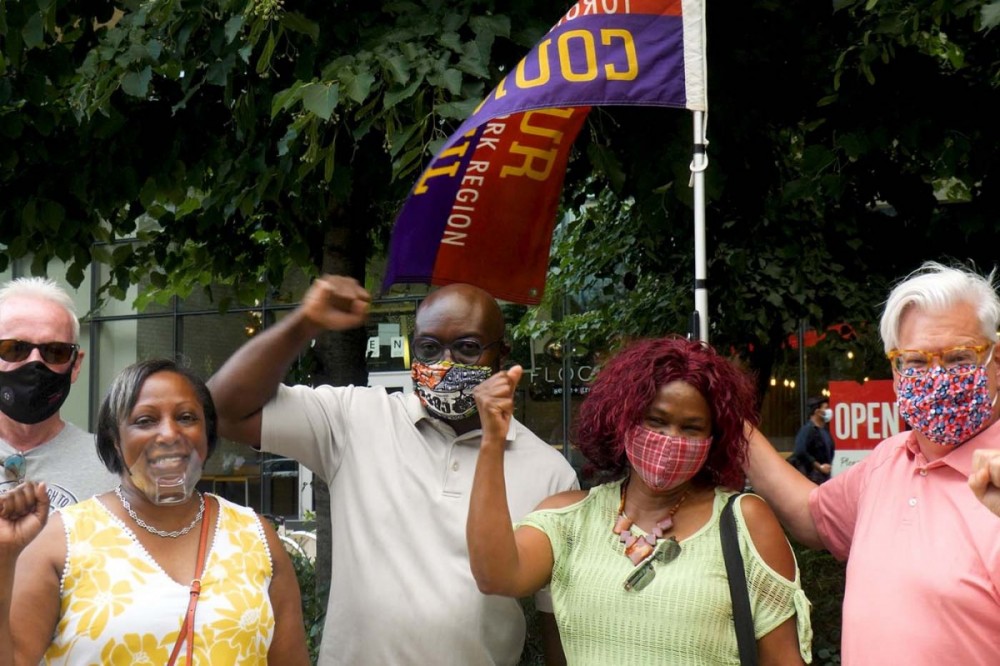
A July 15 Toronto rally for fair wages and working conditions [my emphasis] for University Health Network-Hillcrest healthcare workers. Left to right: Don MacMillan, Yolanda McClean, Mark Brown, Andria Babbington and Fred Hahn. PHOTOGRAPH: NADINE MACKINNON
…
As a labour body, it is imperative that we press towards a just and equitable recovery that benefits workers, their families and the communities that we live in.
We need to get unionization rates up higher than they’ve ever been and build up a consciousness in society, so that we are making sure corporations work for us, not just for the bosses’ profits. This is going to be a huge fight in the next five years.
Let us stop there. What does that mean? And how does she propose to do that? Vague statements like this are pure rhetoric and meaningless. Do not corporations use workers as means to obtain more money (profit) (see the link above on the money circuit of capital)? Such a statement misleads workers into believing that they can somehow “make sure corporations work for us and not just for the bosses’ profits.” This is the illusion of the harmonist vision of social democrats or social reformers everywhere–ultimately, corporations can serve the public good–if there are unions to ensure that they distribute the results of workers’ efforts fairly.
Why is the left in Toronto not calling Babbington to account in making such statements?
Conclusion
The Toronto & York Region Labour Council’s statement that it “unequivocally condemns racism, discrimination, antisemitism, Islamophobia, hate, and all forms of oppression and exploitation [my emphasis]” is union rhetoric. It does not condemn the oppression of exploitation of workers that is necessarily involved when workers work for an employer. It skirts the issue altogether by making meaningless statements such as “we are making sure corporations work for us, not just for the bosses’ profits.”
The left, rather than calling the unions to account for pasting over the real nature of oppression and exploitation at work, generally avoids criticizing them, or they make vague statements about “union sellouts” or the “union bureaucracy.”
Radical leftists need to expose constantly union rhetoric if workers are to face up to the reality of being oppressed and exploited by employers.
I come from a working-class background. My lost paid job was a teacher, substituting for a number of years before obtaining a permanent position. I obtained my doctorate in 2009. I am an unapologetic critic of capitalism and the way in which various institutions and ideologies reinforce it.
View all posts by The abolitionist



 The Abolitionary