In earlier posts in this series, I outlined how a so-called radical here in Toronto, Anna Jessup, probably engaged in bureaucratic manipulation to prevent my participation in a zoom meeting (see for example Exposing the Intolerance and Censorship of Social Democracy, Part Four: Critique of the Idealization of Publicly Owned Infrastructure, Etc.).
Who is Anna Jessup? Here is what chatgpt (artificial intelligence) has to say about her:
Anna Jessup is a Toronto-based activist, educator, and organizer. She has been actively involved in various social justice causes, including homelessness advocacy and supporting pro-Palestinian movements. Jessup has participated in protests against the eviction of homeless encampments in Toronto and has spoken out against the city’s actions towards the homeless population (Global News). Additionally, she contributes to fundraising efforts for protecting affordable housing in Regent Park (GoFundMe).
She stood in front of a backhoe to prevent its operator from demolishing homeless encampments:
During the standoff between homeless individuals and city officials at encampments under a downtown Toronto highway, Jessup took a stand by physically blocking a backhoe to prevent the removal of tents (Global News). She argued that the city’s actions were unjust and that the needs and preferences of the homeless population were not being adequately addressed.
She has also been involved in movements for the abolition of prisons and defunding the police:
She has been actively involved in prison abolition and defunding the police through her work with organizations such as the Toronto Prisoners’ Rights Project (TPRP). TPRP is dedicated to advocating for the rights of prisoners and working towards prison abolition by engaging in direct action, public education, and mutual aid. They focus on highlighting the harms caused by incarceration and providing support to prisoners through various means, including legal, social, financial, and health services (Toronto Prisoners’ Rights Project) (Toronto Prisoners’ Rights Project).
In the realm of defunding the police, Jessup has participated in webinars and discussions that explore community-led alternatives to policing and the broader goals of prison abolition. These efforts emphasize reallocating resources from policing to community support structures and services that can better address the root causes of crime and support marginalized communities (CPEP) (SURJ Toronto).
Jessup belonged to an organization called “Social Housing Green Deal,” and after George Floyd’s murder, it advocated the abolition of the police or at least “defunding the police.” I joined it from around February 20 until May 23, 2021. After the probable bureaucratic manipulation to exclude me from participation, I posted the following:
My conclusions about the efforts of this group, at least in relation to defunding the police (and abolishing it) is: it will not be very effective. Its characteristic lack of critical spirit will result in an incapacity to determine what really is required to defund and abolish the police. Its lack of willingness to critically analyze other organizations’ statements will undoubtedly contribute to that incapacity. Finally, its probable use of control over protocols to silence others expresses as well an incapacity to engage in self-criticism–a basic condition for any political advance.
I wish I were wrong, but given their collapse of strategy into tactics and their lack of a critical spirit–my prediction will probably come true. In May 2022, it will be interesting to see whether the social-democratic left has managed to defund the police to any great extent in Toronto. I doubt it.
Three years after I wrote that–the group “Social Housing Green Deal” does not seem to exist anymore. Jessup may, though, belong to the organization Toronto Prisoners’ Rights Project and to SURJ (Showing Up for Racial Justice). However, she seems to have shifted her focus to the plight of the genocide in Palestine. Flitting from one issue to another with no unified thread is typical of many leftist activists.
But this is an aside.
Jessup probably identifies herself as an activist. I certainly do not engage in this form of activism. The left these days seem to fly from one issue to another without any unified approach or aim to what they are trying to achieve.
Some may question what right I have for criticizing her since she is an “activist.” Such a view is similar to the radical left’s former reluctance to criticize the Soviet Union because, after all, it had created a (so-called) socialist society, or it had achieved a so-called successful revolution.
Activists should not be exempt from a critical examination of their actions–and their views.
The Issue
Despite her probable bureaucractic manipulation, she did not block me from seeing and commenting on her posts on Facebook–not until I began to challenge her views.
I made comments on two images that she posted on her Facebook page. I will address the first image she posted in a later post. I would like to focus on the second image, which is what she posted on her Facebook page:
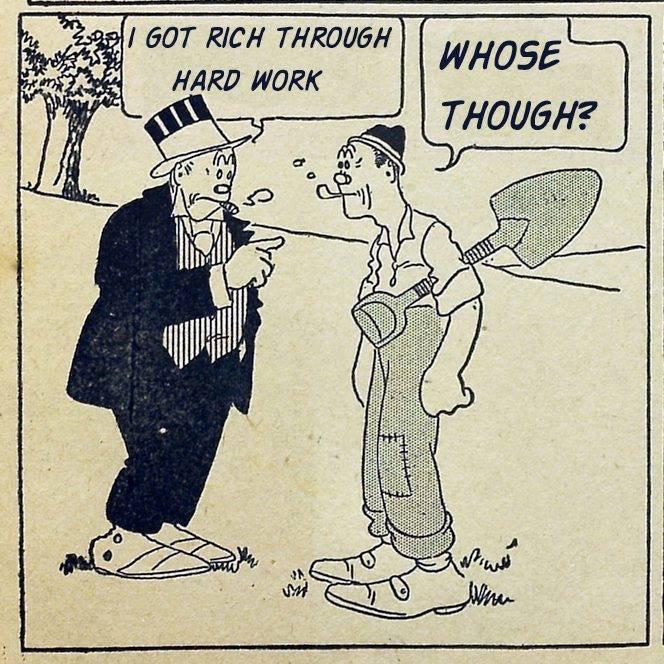
This cartoon appears to link up the work of the workers, exploitation and the generation of a profit. However, such a view was already expressed by a group called the Ricardian socialists. David Ricardo, a political economist of the early 19th century in England, argued that it was mainly labour that determined the value of commodities. Some radical socialists used Ricardo’s theory to criticize the capitalist system.
From A. Anikin (1979), A Science in its Youth: Pre-Marxian Political Economy ,page 379:
The socialists accepted the labour theory of value in the form which Ricardo had given it. They also developed its main tenet to its logical conclusion. The value of commodities is created by labour alone. Consequently, the capitalist’s profit and the landlord’s rent are a direct deduction from this value, which naturally belongs to the worker. Having drawn this conclusion, they saw the contradiction in classical political economy: how could it, based on such principles, regard the system of capitalism, the exploitation of labour by capital, as natural and permanent?
This view, however, is not a Marxian view of the situation:
Pages 380-381:
Like Owen, these economists thought that the exchange between labour and capital violates the law of labour value. They rightly rejected the economic justification of profit by the bourgeois science, but could not put a truly scientific analysis in its place. Since profit from capital did not fit into their system within the framework of “natural” economic laws, they were forced to turn for an explanation of profit to force, deception and other noneconomic factors. As a result the argument for the replacement of capitalism by the socialist order acquired an ethical nature in many respects: justice must prevail. The
essence of justice was that the worker should receive the full product of his labour.This “full (unreduced) product of labour” was destined to have a long life. This demand was utopian from the very beginning: even in a developed socialist society the workers
cannot receive the ” full product” for their personal consumption, for there would not be any funds left for accumulation, for public requirements, the upkeep of the administrative
machine, the elderly, adolescents, etc. The point is that under capitalism there exists a special class of exploiters who appropriate the surplus product, not that the workers do not
receive the full product of their labour. Nevertheless in the 1820s and 1830s this rallying cry was a progressive one, for it promoted the struggle of the working class, which had only just begun.
The struggle of the working class, though, has now continued for two centuries. Do we really need to reproduce ideas that fail to grasp the complexity of the problems which we face? As E. Hunt (1980) remarked in his reference to a Ricardian socialist, William Thompson, in “The Relation of the Ricardian Socialists to Ricardo and Marx,”pages 196-197:
… in his [Thompson’s] hands the labor theory of value was not an instrument for comprehending the functioning of capitalism but a moral norm for advocating socialism. Marx’s criticism of this approach (in The Poverty of Philosophy and elsewhere) is too well known to need repetition here. Thompson can, in fact, only be considered as an economic theorist insofar as he elaborated a very insightful theory of the inherent instability of free market allocation of resources. His case against capitalism and for socialism was primarily moral. And while his moral arguments were elegant and persuasive, he did very little to develop Ricardo’s insights into how capitalism functioned.
The cartoon provides no explanation at all of how the rich obtain their wealth from the work of others.
I questioned Jessup about the post. I wrote the following (admittedly I should have been less polemical–but I also remembered her probable administrative manipuation to exclude me from participating in a zoom meeting). Since I did not trust her, I took a screen shot of what I wrote, her reply, and my response:
This is not surplus value–that is surplus labour. Surplus value includes not just the objective process of the exploitation of workers, but also the objective process through the expression of workers’ labour or work in relations between things (such as the relation between commodities and money). This objective feature of surplus value production hides the fact that workers are exploited. This is one of the reasons why it is difficult to organize against the class of employers and the economic, political and social structures associated with them. There appears to be (and there is at the immediate level of exchange relations) equivalent exchange and hence no exploitaiton.
Jessup’s response:
I wanted to be concise.
My response:
That is not concise; it is confusing. How is that in any way concise. Does being concise involve ignoring the difference between surplus labour (which existed in ancient Greece via slave labour) and surplus labour that assumes the form of value–surplus value?
Please explain how what you posted is concise.
Another person then stated that she thought that surplus value was expressed in money (implying a money profit)–true enough, but such a response does not show how the existence of money itself hides the nature of value and exploitation.
I responded to that person’s statement by referring to Marx’s distinction between abstract labour (which produces value) and concrete labour (which produces use value, say beer)–and how abstract labour, which is not social labour while concrete labour is being performed, needs to be expressed in another and indeed to be realized in another commodity if it is to become social labour. This relation already hides the relations between producers since the producers or workers do not relate to each other as workers directly but only through the intervention or mediation of exchange relations between things. (I elaborate on this issue in a series of posts, “Economics for Social Democrats–but not for the Working Class, Part Three: Critique of Jim Stanford’s Theory of Money,” parts one-three. See for example Economics for Social Democrats–but Not for the Working Class, Part Two: Critique of the Social Democrat Jim Stanford’s Theory of Money, Part One).
The upshot of such a critique is that, ultimately, when the process of capital accumulaiton is taken into consideration, the wage which workers receive is a result of the surplus value which workers produced in previous rounds of capitalist production, but it appears that there is an equivalent exchange.
Cheyney Ryan (1980) explains this situation with an analogy, in his “Socialist Justice and the Right to the Labor Product,” in pages 503-524, Political Theory, Number 4, page 513:
A contract signed under compulsion is void: It is not an “unfair” contract, rather it is not a
contract at all! Focusing on the equity of its terms (as the Ricardian Socialist did) effectively ignores its origins in compulsion.It ignores, moreover, the fact that the capitalist “pays” the workers with goods appropriated from the workers themselves In Theories of Surplus Value, Marx writes that, if we look beyond the “isolated transaction between capitalist and worker,” it becomes evident that “what the capitalist pays the worker. .. is nothing but a part of the worker’s product itself.” Even though “equivalent is exchanged for equivalent, the transaction is for all that only the old dodge of every conquerer who buys commodities with the money he has robbed them of.” The “false appearance” that the capitalist advances something of his own to the worker is yet another” illusion” of the wage form. Under slavery such illusions do not exist, for it is obvious that “what the slave receives as wages is, in fact, nothing that the slave owner “advances” to him, but simply a portion of the realized labour of the slave that returns to him in the form of means of subsistence.” Now the fact that the capitalist has no right to the goods he exchanges for labor has strong bearing on how we criticize that exchange. Consider an analogous case: You own and old baseball bat and a very fine tennis racket, neither of which you use very often and which have been sitting in your closet for quite a while.One night I sneak into your closet and steal the bat, but I decide later that I would rather have the tennis racket instead. In exchange for the racket I offer you (your) baseball bat, which I represent as my own after painting it a new color. Gullibly, you accept. It may well be that the tennis racket is worth quite a bit more than the baseball bat, and that the “exchange” is extremely unequal. But to condemn the transaction on these terms would ignore the real wrongdoing here, the fact that one of the parties( me) has no right to engage in the transaction in the first place (viewing this transaction as simply an exchange overlooks this feature). So, too, with the wage bargain: It is the legitimacy of the whole transaction that must be questioned-the owner’s right to the goods offered in “exchange” for labor.
Behind the apparent equality of the wage bargain (the exchange ofequivalents) is inequality ( the capitalist owns everything, the worker nothing). Behind the formal freedom of the bargain (the fact that workers can sell labor to whomever they choose) is unfreedom (workers are forced to sell their labor). What looks like an exchange is not a true exchange, since the owner pays the worker with the workers’ own goods [hidden by the wage form].
In the context of capital accumulation, I explain the same process in more detail by quoting substantially from Otani (2018), A Guide to Marxian Political Economy: What Kind of a Social System Is Capitalism? in Review of Thier’s Book “A People’s Guide to Capitalism,” Part Four.
I also pointed out that the fact that concrete labour and its social counterpart are split so that crises arise.
Unfortunately, I did not have time to take a screen shot of my reply to the second person’s response. Jessup apparently blocked me from her Facebook page.
Of course, according to Facebook protocols, she has the right to do so. However, in addition to the probable manipuation of bureuacratic procedures to exclude me from participating in a zoom meeting, this act of failing to engage in debate and the act of blocking indicate a decided anti-democratic bias on the part of this “activist.”
The birth of democracy in ancient Greece involved debating the issues. From G. de Ste Croix (1981), The Class Struggle in the Ancient Greek World: From the Archaic Age to the Arab Conquests, pages 284-285:
Since public debate was an essential part of the democratic process, an important ingredient in democratic eleutheria [freedom] was freedom of speech.
Many so-called leftist activists apparently believe, because they are activists, that they can make any assertion that they want, and they need not justify themselves. Such a lack of a democratic attitude among many so-called activists is hardly what the working class, citizens, immigrants and migrant workers need.
Conclusion
In any case, given the superficial nature of Jessup’s point of view and activism, I will predict that she may well end up becoming a right-wing advocate as her efforts will likely come to nothing. She will become tired of banging her head against a wall that she does not understand; she will also get tired of flitting from one social issue to another without engaging in any depth with the issues.
It will be interesting to see what Jessup has accomplished in the next five years and in the next 10 years. Being an activist with a superficial view of the world and full of cliches (considered to be “concise”) hardly serves anyone’s interests–except for pure activists whose identity politics is just that–to identify as an activist.
Appendix
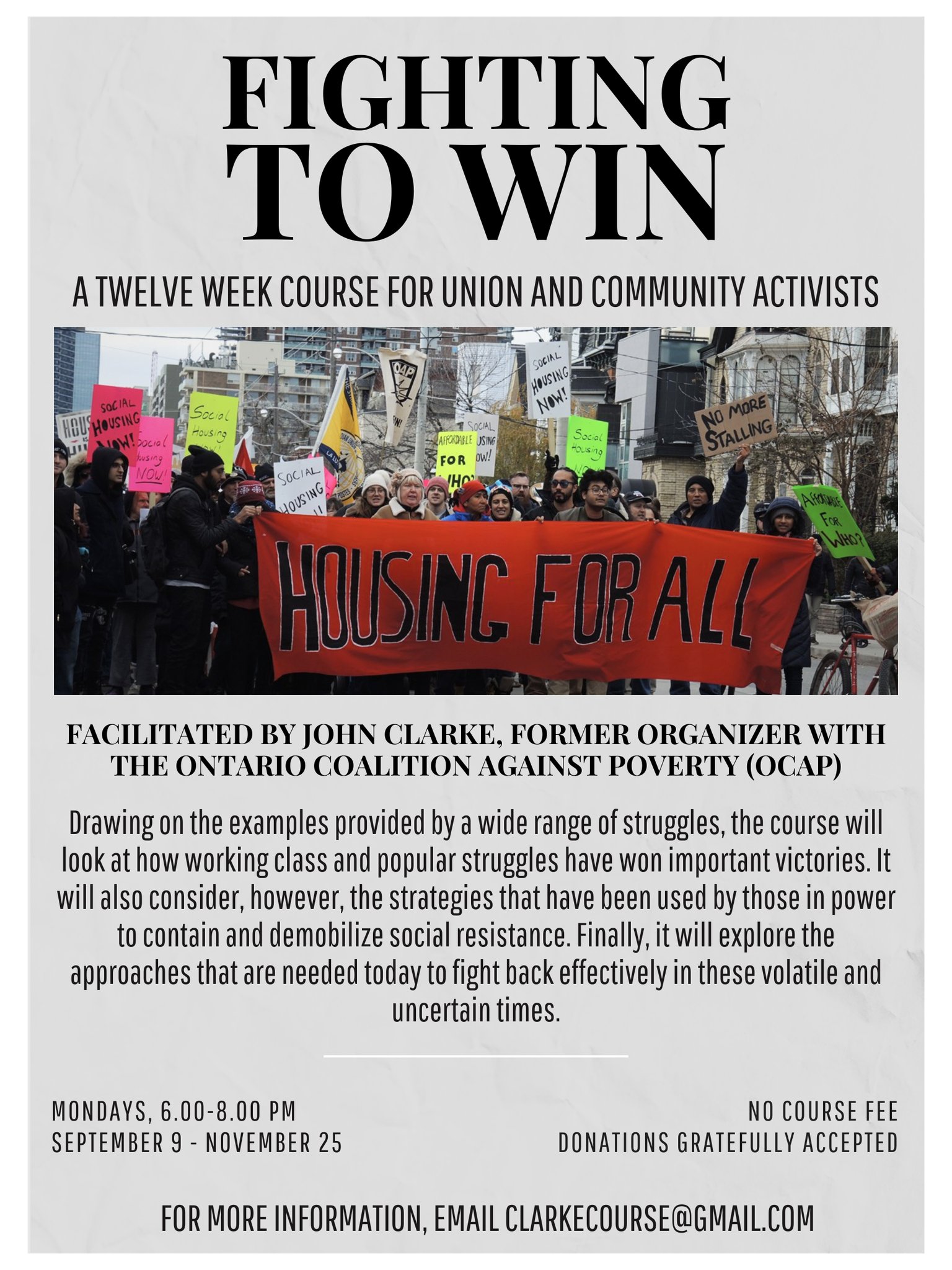
Jessup is an activist. John Clarke, a former major organizer for the Ontario Coalition Against Poverty (OCAP), will be holding a course for “community and union activists.” Let us hope that he will not indulge such activists in their prejudices and limitations. It is not in the interests of the working class, citizens, immigrants and migrant workers to accept the superficial views of such activists; it is in their interests to challenge such superficial views.

 The Abolitionary