John Clarke, former major organizer of the defunct Ontario Coalition Against Poverty (OCAP), wrote the following recently (October 6, 2025):
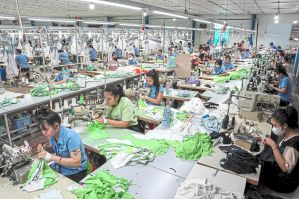
The unresolvable contradiction within capitalist society is that they need us but we don’t need them. TOPSHOT – Vietnamese garment factory workers stitch apparel at a factory in Ho Chi Minh City on April 3, 2025, after US President Donald Trump unveiled sweeping new tariffs on trading partners. At a garment factory in Ho Chi Minh City that exports T-shirts and underwear to the United States, staff are alarmed by “shocking” trade tariffs imposed on Vietnam that could severely impact their business. (Photo by Huu Kha / AFP) / To go with ‘VIETNAM-US-TRADE-TARIFF,FOCUS’ by Lam Nguyen and Alice Philipson in Hano
I beg to differ. Of course, in an absolute sense and in the long term, workers do not need employers–in a socialist society, but any society always needs workers.
However, from the experiences of workers in a capitalist society, they learn that in the short term they do indeed need employers. The problem, ideologically and organizationally, is to have workers realize that their short-term interests and their long-term interests coincide so that they attempt, in the short-term, to realize their long-term interest of abolishing their exploitation and oppression.
Clarke’s line—“they need us but we don’t need them”—brings to mind a moment from the First International, when a speaker declared that language barriers would soon disappear, and yet his words had to be translated for the room to understand. Both capture a truth and a contradiction at once: the dream outruns the reality. Workers shouldn’t need the bosses any more than humanity should need translation to understand itself—but until the world is remade, both dependencies remain. The power lies in naming that contradiction and turning it into movement.
On a practical level, Clarke’s statement is politically useless.
I come from a working-class background. My lost paid job was a teacher, substituting for a number of years before obtaining a permanent position. I obtained my doctorate in 2009. I am an unapologetic critic of capitalism and the way in which various institutions and ideologies reinforce it.
View all posts by The abolitionist

 The Abolitionary