Introduction
As I indicated in an earlier post, I attended the second session spring 2024 education conference of Socialist Action (https://www.youtube.com/watch?v=DA-mVbaSSOc&t=4354s) since the issue of what socialists should do in unions is of prime importance- but was excluded from it after I asked a couple of questions in the chat and responded to Barry Weisleder’s response to one of my chat questions (see An Interesting Response from Barry Weisleder, Canadian Federal Secretary of Socialist Action, located in Toronto). The questions were:
- What do socialists do to show the limitations of collective bargaining and collective agreements?
- [Lisa,one of the presenters referred to public ownership at one point]: Can public ownership not involve exploitation and oppression just as much as in the private sector?
I also asked, as a supplement, whether social reformers and social democrats do not tend to idealize the public sector.
Barry Weisleder, federal secetary of Socialist Action Canada, then replied that public ownership is a step forward and that workers could advance through their struggles against both public and private employers. I then replied that this sounds contradictory since the conclusion that public ownership is a step forward does not follow logically from the idea that workers in both the public and private sectors could advance their struggles in both sectors.
Barry then quickly replied that this is not a debate but a socialist conference; I had little time to read any more of what he actually wrote since he booted me off not only chat but off of zoom.
Given the Youtube presentation of the conference, I can now provide a critical look at Julius Arscott’s presentation. I look at his presentation since Arscott is a former executive member of the Ontario Public Service Employees Union (OPSEU) and a member of Socialist Action.
I will not follow the order presented at the conference but rather focus on certain themes. The first theme is Arscott’s reference to OPSEU’s Strategic Action Plan. Arscott was elected to the Strategic Planning Committee. Arscott claims the following (almost verbatim):
His union now prioritizes building public-service worker power to advance social and economic justice for all workers, with the values of the union being member-driven and worker-centered with a focus on diversity and inclusivity.
The union’s goals include challenging bosses and anti-worker legislation at a greater scale, collective bargaining leading to better and more inclusive contracts, creating a culture that supports strategic risk taking and members seeking and members seeing clear actions to advance equity–anti-black racism, anti-indigeneity at every level of the organization. All of this and more is laid out in the Strategic Plan, which is a recent document which was approved by the board, and none of it would have happened without the hard work of socialists over many years in our union [my emphasis].
Arscott’s claim is that it was due to the activity of socialists over many years that resulted in specific content existing in the Strategic Action Plan. Without socialists, the content would not exist.
What specifically is socialist about the Strategic Action Plan? Arscott fails to indicate that. The following may be what he means by socialist content:
- challenging bosses
- challenging anti-worker legislation at a greater scale
- collective bargaining leading to better and more inclusive contract
- creating a culture that supports
- strategic risk taking
- members seeking clear actions to advance equity–anti-black racism, anti-indigeneity at every level of the organization
1. Challenging the bosses may or may not be socialist. What does that mean–challenging the bosses? Arscott does not elaborate. It is vague. If it were socialist, it would mean challenging not only the power of a particular employer but the power of the class of employers, or employers as a group. It would also mean challenging the economic and political structures associated with such class power–such as money as an independently produced power by workers that controls them rather than workers controlling what they themselves produce.
The idea of “challenging the bosses” remains vague in the document and enlightens no one about the nature of the problems which workers face as a class. By not defining the problem more clearly, it is much more difficult to outline possible solutions–and this is what Arscott does not do.
2. challenging anti-worker legislation at a greater scale
This measure is certainly necessary to provide more room for manouever for the working class, but in itself it could just as well be reformist. There is no indication by Arscott how this measure links to the aim of challenging the class power of employers. Furthemore, there is no mention of how effective such a challenge was.
3. collective bargaining leading to better and more inclusive contract
This measure could only be considered socialist if it was somehow linked to wider measures that challenge the class power of employers. As it stands, it could well be a reformist measure that idealizes collective bargaining and collective agreements.
4. creating a culture that supports
-
- strategic risk taking
- members seeking clear actions to advance equity–anti-black racism, anti-indigeneity at every level of the organization
Strategic risk taking is vague. In practice, OPSEU, once J.P. Hornick became president, has certainly engaged in more militant actions (such as supporting the illegal CUPE education workers strike in 2022). From https://opseu.org/news/opseu-sefpo-education-workers-to-walk-out-in-solidarity-with-cupe-colleagues/179590/:
OPSEU/SEFPO education workers to walk out in solidarity with CUPE colleagues
I Stand With Education Workers #39KisNotEnough OPSEU/SEFPO
November 3, 2022 – 7:46 am
Press Release
Bargaining, Bargaining News, Political action, Provincial
Boards of Education and Cultural Institutions, Education
FOR IMMEDIATE RELEASE
November 3, 2022TORONTO – OPSEU/SEFPO education workers will walk off the job this Friday in a monumental show of solidarity with their CUPE colleagues who are set to stage a province-wide protest against Stephen Lecce and the Ford government’s Bill 28.
Bill 28, which is a legislative attack on workers’ constitutional right to fair and free collective bargaining, was introduced on October 31 after CUPE gave its five days’ notice for job action, with the possible start of a strike on Friday, November 4. Bill 28 preemptively prohibits these workers’ right to strike, imposes massive fines, imposes four-year long collective agreements, and invokes the notwithstanding clause to preclude any legal action against Ford’s unconstitutional and undemocratic attempt at strong-arming.
Bill 28 isn’t just an attack on education workers’ collective bargaining rights, it is an attack on all workers’ rights. And after hearing from hundreds of our education workers and their local leaders who want to support their CUPE colleagues, our response to this unprecedented legislative overstep is clear: OPSEU/SEFPO education workers will walk out in solidarity with their CUPE colleagues this Friday.
The following message from OPSEU/SEFPO President JP Hornick and First Vice-President/Treasurer Laurie Nancekivell was sent to all OPSEU/SEFPO Sector 3 education workers last night:
Dear friends,
Many of you have been asking us what the plan is this Friday, November 4 for OPSEU/SEFPO education workers. We have heard from so many of you, telling us you want to support and join your CUPE colleagues and walk off the job this Friday in solidarity with them.
You’ve told us that the attack on education workers by Stephen Lecce and the Ford government this week is so harmful that we have to do everything we can to fight for our rights.
We have heard you.
We will support every OPSEU/SEFPO education worker who does not attend work this Friday.
If you are not attending work, join the nearest CUPE picket rally, if you can.
Click here to find the nearest CUPE rally to you by postal code.
Your union will have your back. You will not have to pay any fines. And you will have the full force of OPSEU/SEFPO behind you should your employer attempt to enact any discipline.
We have 8,000 education workers in our union. If you all walk out together on Friday, there is safety in numbers. Talk to your colleagues. Make plans with them to attend a nearby CUPE rally together.
You didn’t ask to be on the front lines of this fight, but you are strong. And we will have your back when you go out on Friday.
Stay tuned to http://www.opseu.org – we will post information, including answers to your questions, in the next 24 hours.
In solidarity,
JP Hornick, OPSEU/SEFPO President
Laurie Nancekivell, OPSEU/SEFPO First Vice-President/Treasurer
Such militancy is indeed to be welcomed. However, being militant does not mean that there is a move towards challenging the class power of employers; rather, it is more defensive than offensive. To be a socialist move, it would have been necessary to link such a defense of workers engaging in an illegal strike with a critique of the legitimacy of the collective-bargaining process and collective agreements (with the necessity, for now, of engaging in such a process due to limited power). Hornick and OPSEU in general have no intention of doing so. This situation is clear when we consider how OPSEU, like many other unions, express frequently such cliches as “fair contracts (see ???).
As for a “culture that supports members seeking clear actions to advance equity–anti-black racism, anti-indigeneity at every level of the organization,” such efforts are to be lauded as a means of reducing divisions within the working class and to right wrongs perpetrated against peoples of colour in the past. However, again, there is nothing specifically socialist about such measures.
Arscott’s implied claim that without his presence as a socialist in the Strategic Planning Committee the plan would be substantially different at best probably refers to the statement concerning “challenging the bosses”–which hardly provides any concrete direction for the formation of policy and engaging in action.
Let us look at another stratetic plan created by a public service union: the Canadian Union of Public Employees (CUPE), titled: Reclaiming worker power: Strategic Directions 2023-2025.
There is no direct reference to “challenging the bosses,” but there is an indirect reference on page 7:
Exercise our power in our fight for a better world and when our rights are under attack, to show governments and employers alike that we aren’t afraid to take to the streets.
Apart from that indirect reference to “challenging the bosses,” the document identifies the main problem as “corporate greed”. From page 1:
The right is capitalizing on the desperation of working families, hoping to divide us so that we fear and fight with each other, rather than organizing together and fighting back against the root cause of our struggles – corporate greed.
The concept of “corporate greed,” like “challenging the bosses,” is vague. What does it mean? Does it mean that all corporations are greedy in that they, to be corporations, must have as their primary goal and drive obtaining more and more money (a Marxist interpretation)? Or does it mean that corporations are currently greedy but in the past were not–that they somehow did not aim for obtaining more and more money? This meaning–that corporations are currently greedy but were, implicitly, not greedy in the past, is what CUPE means since it also argues that corporate profits are now excessive. From https://cupe.ca/federal-budget-must-tackle-corporate-greedflation-and-support-working-families:
Budget 2023 should take a stand against corporate greed [my emphasis] by taxing excess profits of corporate giants like Loblaws who posted $529,000,000 in profits in the 4th quarter of 2022, while 5.8 million Canadians – including 1.4 million children – were experiencing food insecurity.
Taxing excess corporate profits would curb corporate profiteering [my emphases], saving working people money on the cost of housing and everyday goods, while also generating revenue that can be used to deliver services that make life more affordable for everyone.
Claiming that the main problem is corporate greed (a.k.a. excess profits) means that CUPE accepts regular profits (which come from exploiting workers), but wants corporations to pay their “fair share” of taxes. It may even be that those who talk of “corporate greed” conceive challenging it as “challenging the bosses.”
The claim that the problem is “corporate greed” and that challenging it will somehow resolve the problems which workers, citizens, immigrants and migrants face is just as socialist as the view that it is necessary to “challenge the bosses”–neither really gets at the roots of the problem in the need to create a movement that challenges the class power of employers.
As for “challenging anti-worker legislation at a greater scale,” we read on page 5:
- Oppose the use of scab workers during labour disputes, and advocate for strong anti-scab legislation in all jurisdictions across Canada. …
- Defend our right to strike, and our right to respect the picket lines of other striking workers.
The third point in OPSEU’s Strategic Action Plan–“collective bargaining leading to better and more inclusive contract”–also has parallels in CUPE’s Strategic Directions document. From page 4:
- Strengthen and expand coordinated and sectoral approaches to bargaining, to bring our full negotiating power to bear.
• Proudly continue following our bargaining policy of no concessions and no two-tiered agreements to ensure our members are always moving forward – never backward. …- Negotiate collective agreement language to protect against understaffing and precarity, and ensure inclusivity, employment equity and safe spaces in our workplaces.
I do not see any equivalent to “Strategic risk taking” in the document, but since it was CUPE education workers who staged an illegal strike and, with the help of other unions (including OPSEU) and community members, forced the Conservative Doug Ford government to repeal Bill 28, which would have forced the workers to go to work even before they struck and used the nonwithstanding clause in the Charter of Rights and Freedom to prevent workers from using the legal process to challenge the law), CUPE in practice just as much engaged in “strategic risk taking” as did OPSEU.
Finally, the reference in the OPSEU Stratetic Plan to a “culture that supports members seeking clear actions to advance equity–anti-black racism, anti-indigeneity at every level of the organization,” has parallels in the CUPE document. On page 1, we read:
Indigenous members, Black and racialized members, 2SLGBTQI+ members, young workers, persons with disabilities, our communities, our climate, and our families are being threatened by the right-wing, by white supremacy, and by the greed of capitalism.
Indeed, there is a whole section on the issue of addressing indigenous concerns. From page 2:
Reconciliation with Indigenous Peoples
The work of reconciliation belongs to everyone, and as Canada’s largest union, we recognize that we have a major role to play in that work – as an organization, and as a national network of community activists. As part of our ongoing commitment to truth and reconciliation, over the next two years, CUPE will:
• Continue supporting Indigenous communities in calling for the implementation of the Truth and Reconciliation Commission’s 94 Calls to Action.
• Support the calls to justice for Missing and Murdered Indigenous Women, Girls, and Two-Spirit people, and pressure the federal government to implement the federal action plan.
• Support the implementation of the 2023 United Nations Declaration Act Action Plan to bring federal laws and policies in line with UNDRIP, the United Nations Declaration on the Rights of Indigenous Peoples.
• Advocate for policy changes that address historical injustices and improve the quality of life for Indigenous communities.
• Improve representation of Indigenous union members within our organization, addressing barriers to their full participation and advancement.
• Support initiatives by Indigenous communities to combat environmental racism, promote cultural preservation, traditional land stewardship and conservation practices.
• Promote awareness and action for September 30th, the National Day for Truth and Reconciliation, and pressure provincial governments to recognize the day as a statutory holiday for reflection.
• Strengthen our relationships with progressive Indigenous organizations, especially with local, regional and grassroots Indigenous-led groups.
• Continue promoting the importance of water as a sacred resource that belongs to everyone, not for the profit of a few, in the same vein of CUPE’s Water Is Life campaign.
• Advocate for the creation of a Red Dress Alert to notify the public
On page 3, there is also reference to concerns for fighting against racism against Black peoples:
Continue our fight against anti-black racism, commemorate the end of the UN Decade for People of African Descent in 2024, and continue celebrating Black history beyond 2024.
Conclusion
Arscott’s efforts in creating a “socialist document” as expressed in the Strategic Action Plan of OPSEU seems to fall far short of anything approaching a real socialist document. At best, it contains a vague reference to challenging the bosses, but other than that, its content has parallels with a similar document produced by CUPE.
Arscott’s claim that his efforts have somehow created a socialist document rings hollow. There is little wonder that I was expelled from the Conference which was supposedly open to everyone: its representatives could not show how what they did generally advanced a socialist agenda that challenged the class power of employers.
Addendum
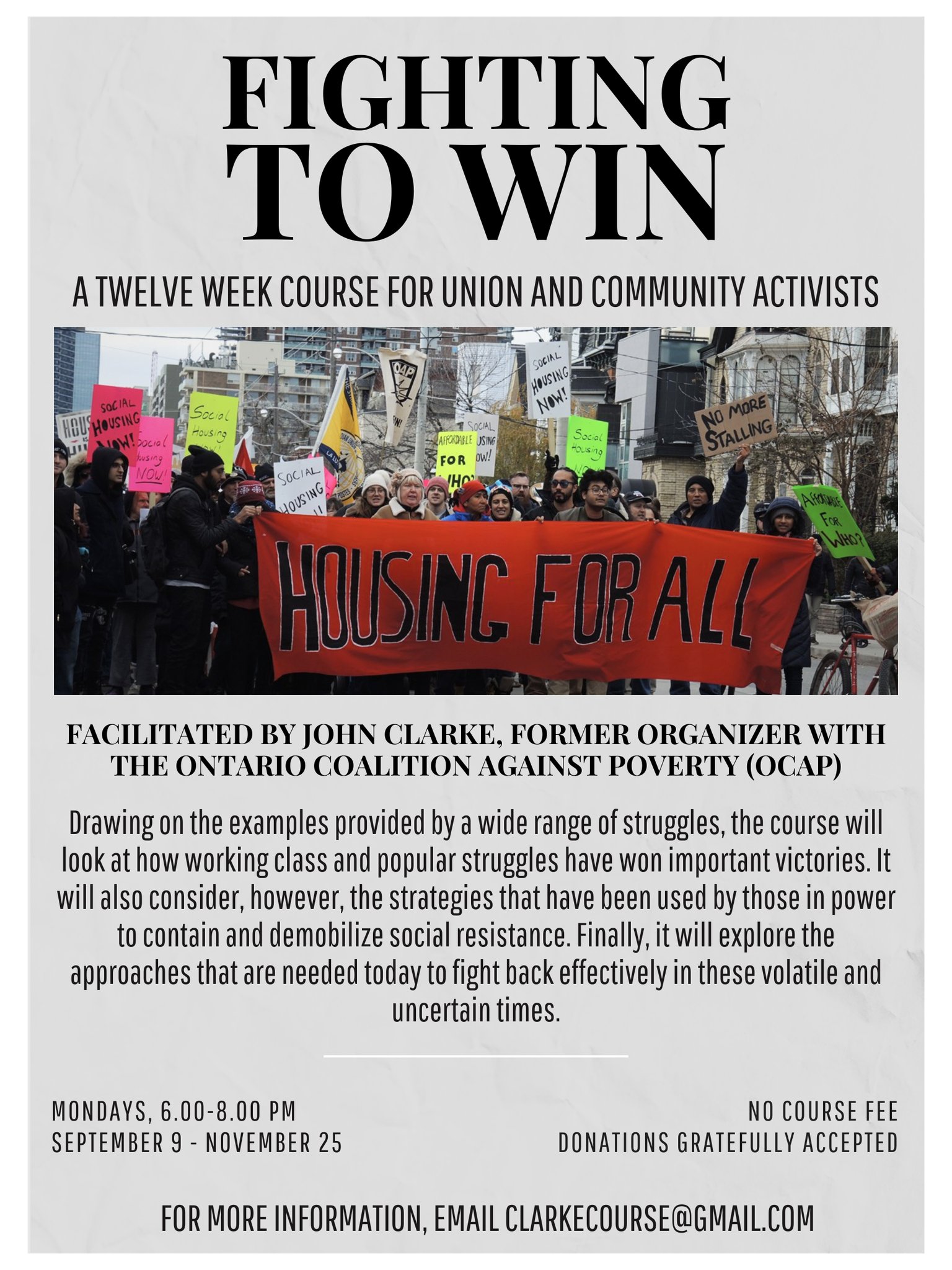
Arscott is an activist. John Clarke, a former major organizer for the Ontario Coalition Against Poverty (OCAP), will be holding a course for “community and union activists.” Let us hope that he will not indulge such activists in their prejudices and limitations. It is not in the interests of the working class, citizens, immigrants and migrant workers to accept hollow claims. Participants must be challenged if they are not to be co-opted. From Paulo Freire (1993), Pedagogy of the Oppressed, revised edition, page 90:
People, as beings “in a situation,” find themselves rooted in temporal-spatial conditions which mark them and which they also mark. They will tend to reflect on their own “situationality” to the extent that they are challenged by it to act upon it. Human beings are because they are in a situation. And they will be more the more they not only critically reflect upon their existence but critically act upon it.
It waits to be seen whether Clarke will indulge in the wooden beliefs of some activitsts or whether he will challenge them to reflect critically on their own situations in this world and on the situations of others.

 The Abolitionary