This post connects to the broader argument outlined in The Money Circuit of Capital.
Introduction
I was disappointed when seeing the following recent post by John Clarke, former major organizer for the defunct Ontario Coalition Against Poverty (OCAP):
Solidarity with flight attendants!
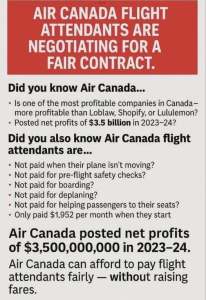
I certainly express solidarity with the flight attendants as well–but I would never simply post this without making several critical comments.
Critique of Clarke’s Silence
Firstly, it is probable that this comes from the union representing Air Canada flight attendants–the Canadian Union of Public Employees (CUPE). I have already shown that this union–the largest Canadian union–uses the cliche of “fair contracts” often enough (without ever justifying the cliche) (Fair Contracts (or Fair Collective Agreements): The Ideological Rhetoric of Canadian Unions, Part One: The Canadian Union of Public Employees (CUPE). Such a cliche serves to hide the fact that no contract (including collective agreements) can express something fair since the employment relation involves treating human beings as things to be used for purposes undefined by those human beings–as mere means to other persons’ ends (and, in the context of Air Canada, as a means for obtaining more money–see the money circuit link mentioned at the beginning of this post).
Clarke should have called into question the union rhetoric of a “fair contract.” That he did not indicates a major problem with his approach to working-class interests.
Secondly, the reference to “more profitable” is deceiving. Air Canada may or may not be more profitable than Loblaws, Shopify or Lululemon. It may have received more profit than these other capitalist employers, but “more profitable” is not measured by the absolute level of profit but by the level of profit divided by expenses (in Marxian terms, constant capital (purchase of airplanes, fuel costs, etc.) plus variable capital (salaries and benefits)–which is called the rate of profit.
For example, if you invested $10,000 and received $5000 in profit, the rate of profit would be 5000/10,000=50%. If you invested $100,000 and received $6000, you would receive more profit, but the rate of profit would be much less: 6000/100,000=6%.
At a minimum, Clarke should have calculated the rate of profit of Air Canada, Loblaws, Shopify and Lululemon in order to determine whether Air Canada was indeed more profitable.
Thirdly, in addition to the rate of profit, which includes c as part of the calculation, there is the rate of exploitation, which only relates the profit (what Marxian economics calls surplus value s) to salaries and benefits, or v. Generally, the rate of exploitation is higher than the rate of profit. Clarke should have also included reference to this when referring to “more profitable” since a capitalist company may have a lower rate of profit but a higher rate of exploitation.
For example, if a company invests $50 million, with c=$40 million and v=$10 million and s=$10 million, the rate of profit is 10 million/50 million=20%, but the rate of exploitation is 10 million/10 million=100%.
Another company may invest the double the amount but with different proportions between c and v, with a much higher rate of exploitation despite a lower rate of profit and a lower level of absolute profit.
For example, if a company invests $100 million, with c=$95 million and v=$5 million, but s=$8 million, the absolute amount of profit is less than the first ($8 million is less than $10 million), and rate of profit is also less (8 million/100 million=8% is less than 20%), but the rate of exploitation is higher (8 million/5 million=160% is greater than 100%).
Finally, I had calculated the rate of exploitation of Air Canada workers a few years ago (see The Rate of Exploitation of Workers at Air Canada, One of the Largest Private Employers in Canada)–but Clarke makes no reference to this nor does he update it for 2023-2024 (nor criticize my calculations in order to improve them).
Conclusion
Clarke simply fails to do what a critic of capitalism should do: engage in inquiry rather than reproduce the rhetoric of the social-democratic or social reformist left. Clarke’s silence concerning these issues is indicative of part of the problem with the left these days.


